
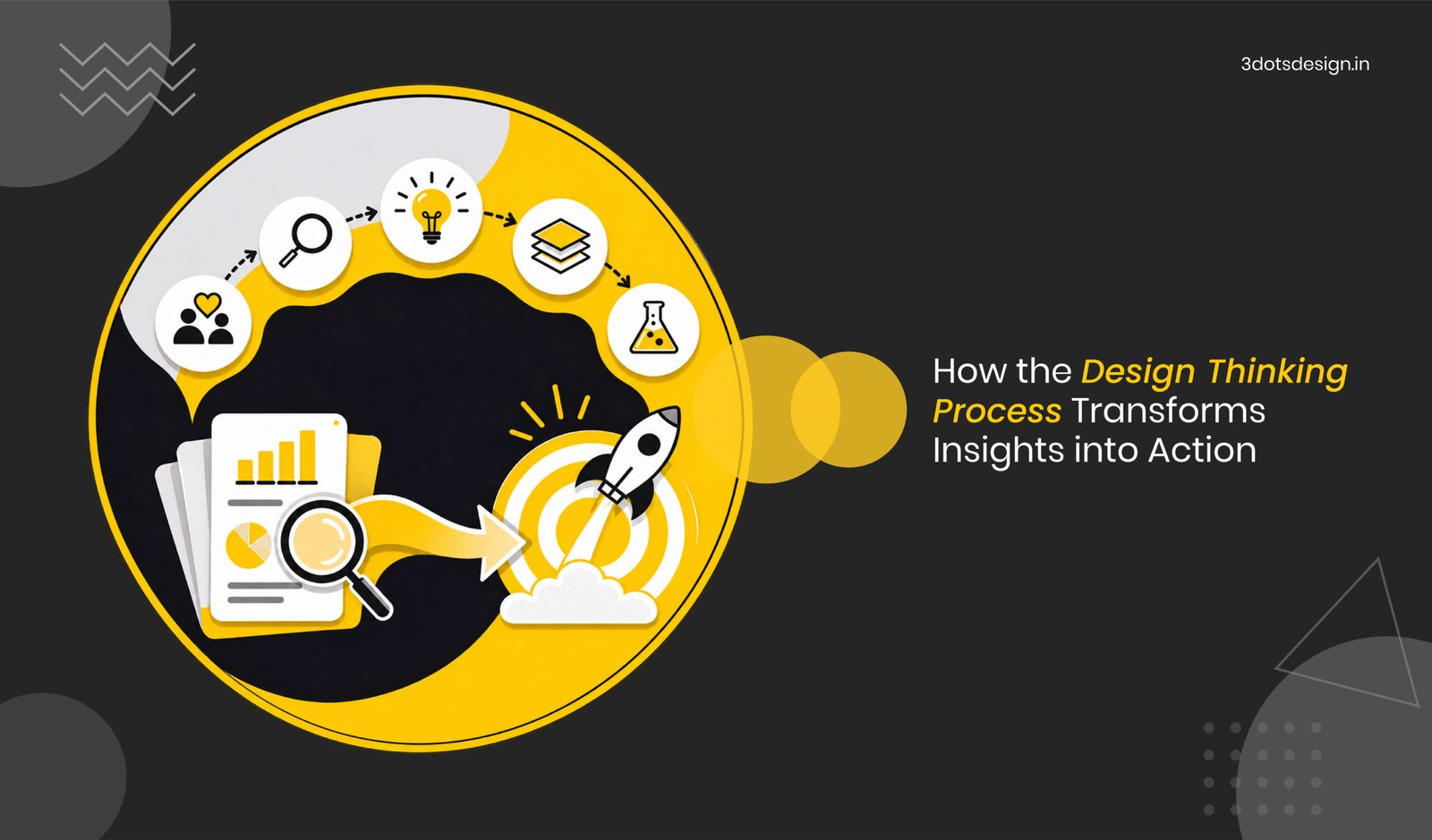
Great ideas don’t happen all at once. They take shape when we understand people, question assumptions, and explore new possibilities. That’s where design thinking comes in. It helps us solve problems through research, creativity, experimentation, and continuous improvement.
What Is the Design Thinking Process?
- The design thinking process is a structured yet flexible approach to problem-solving that places people at the centre of every decision.
- It combines observation, research, creative thinking, prototyping, and testing to develop solutions that are desirable for users, technically feasible, and commercially viable.
- The approach is useful across industries, including product design, technology, marketing, branding, customer experience, and service development.
A Visual Walkthrough of the Design Thinking Process
The design thinking process is often represented through five core stages:
- Empathise- Understand users and their needs.
- Define– Frame the right problem to solve.
- Ideate-Explore multiple possible solutions.
- Prototype-Make ideas tangible and testable.
- Test-Learn from feedback and improve.
7 Design Thinking Process Steps
1. Frame a Question Define the Challenge
A well-framed question should be open-ended, centred on people, and focused on an opportunity rather than a predetermined solution. Before brainstorming solutions, identify what needs to change, who is affected, and why the challenge matters.
- Identify the key challenge and the people affected by it.
- Review existing information, business goals, and known constraints.
- Separate assumptions from verified facts.
- Frame a question that encourages different approaches.
2. Gather Inspiration Research and Empathy in Action
Once the challenge is defined, the next step is to understand the people experiencing it. This involves observing their behaviour, listening to their experiences, and exploring the context in which they interact with a product, service, or brand.
- Interview users and observe real-world behaviour.
- Review reviews, support queries, and customer feedback.
- Map the user journey to identify friction points.
- Explore the emotional and practical needs behind user decisions.
3. Synthesize for Action Turn Research into Insights
Teams can organise research using affinity mapping, empathy maps, customer journey maps, and user personas. These methods help highlight recurring challenges and distinguish meaningful findings from isolated observations.
- Group similar observations and recurring themes.
- Identify unmet needs and common frustrations.
- Challenge assumptions using the research findings.
- Translate patterns into clear problem statements.
4. Generate Ideas Expand Creative Possibilities
Brainstorming, mind mapping, sketching, SCAMPER, and “How Might We” questions can encourage teams to approach a challenge from different perspectives. Once ideas are generated, the team can evaluate them against user needs, business objectives, technical feasibility, and available resources.
- Encourage independent thinking before group discussion.
- Generate several approaches to the same challenge.
- Combine or build upon promising ideas.
- Prioritise concepts using clear evaluation criteria.
5. Make Ideas Tangible Rapid Prototypes
A prototype is an early representation of an idea that allows teams to explore how it might work. It can be as simple as a paper sketch, a storyboard, a product mock-up, or a clickable digital wireframe. The purpose is not to create a polished final product. It is to make an idea tangible enough for people to interact with and provide useful feedback.
- Select the idea you want to explore first.
- Build a prototype suited to the question being tested.
- Focus on the most important user interaction or feature.
- Keep the prototype simple enough to change quickly.
6. Test to Learn Refine Solutions Through Feedback
Usability testing, feedback sessions, task-based observation, and controlled experiments can reveal whether the proposed solution addresses the original challenge. Feedback should be treated as evidence for improvement, not merely as approval or rejection.
- Define what you want to learn before testing.
- Ask representative users to complete relevant tasks.
- Observe behaviour instead of relying only on opinions.
- Identify friction points and make evidence-based changes.
- Repeat testing when further refinement is needed.
7. Share the Story Communicate Ideas That Resonate
The final step brings together the original challenge, research findings, creative direction, prototype, and lessons learned into a story that stakeholders can understand and act upon. This is crucial when presenting a design concept to clients, leadership teams, development partners, or other decision-makers.
- Explain the problem and the insights behind it.
- Demonstrate the solution through visuals or prototypes.
- Connect design decisions to user and business needs.
- Present test findings, limitations, and recommended next steps.
How a Design Agency in Pune Can Help Apply Design Thinking
Working with a design agency in Pune can help businesses turn design thinking principles into a practical workflow. This may include:
- Research and discovery
- Brand and communication strategy
- Digital experience design
- Creative concept development
- Prototyping and validation
- Design refinement
When evaluating an agency, look for a clear understanding of your objectives, a research-led approach, transparent communication, and the ability to explain why a particular design direction is appropriate for your audience.
At 3 Dots Design, our experienced team brings research, strategic thinking, creative exploration, prototyping, and testing together to create brand communication that delivers excellent results. Get in touch to discover how.