
Scroll through any feed on the morning of a festival and you’ll see the same post a hundred times with a different logo in the corner. Festive marketing starts to look the same because we all begin in the same place: a folder of images that leads everyone back to the same ten pictures. The posts people remember start earlier, with words, then a real link between the festival and the brand, then an idea simple enough to get in a second.
Getting there is harder than it sounds. The copy team goes quiet and the notebooks come out, because somebody is sure there’s a wish nobody has written before and they’ll find it even if it eats the whole week. It does eat the whole week. The designers open fourteen tabs, hunting for a diya that looks unlike any diya they’ve seen, or a kite, or a dhol, or a kite holding a dhol if things get desperate. Social media and client servicing are on a call explaining to a cement brand why Raksha Bandhan is deeply relevant to it, and relevance is being manufactured by hand.
Anybody who has spent a festive season inside a digital marketing agency has sat in one of those three chairs. Maybe you’re in one right now, with a post due on Friday and nothing in your head except a diya. Here is the order we work in when we want an idea nobody else posted, along with the creatives that taught us each step.
Map the words before you open a single image
Crafting the creative begins on a sheet of paper with words on it. For Raksha Bandhan, we wrote down everything around the relationship instead of the ritual. Siblings tease each other, fight, borrow things without asking and somehow make each other better. Three words kept coming back from that list: rough, edges and sharp.
Those three words also describe a pencil, which only gets sharp after somebody shaves its edges. That’s when the hunt began, and it was the real work, because we spent a good while going through objects in our own world until one of them said the same thing as the words. A curled shaving looked a lot like the middle of a rakhi, so the sharpener became the centre stone and a scribble of graphite became the thread running out on both sides. The line “Some bonds are rough around the edges but they keep you sharp” was already waiting.
View this post on Instagram
Next time, write fifteen words around the feeling of the occasion before you look at a single reference. Circle the ones that could also describe something sitting on your desk or in your client’s shop, then go looking for the object. Expect it to take a while.
Find where the festival and the sector meet
Every festival means a hundred things and your client needs only one of them. A real estate brand can take Gudi Padwa and see a gudi raised outside a new home, which already belongs to its world. Some festivals have no such overlap with some brands, and in that case a warm and simple wish does far better than a forced concept.
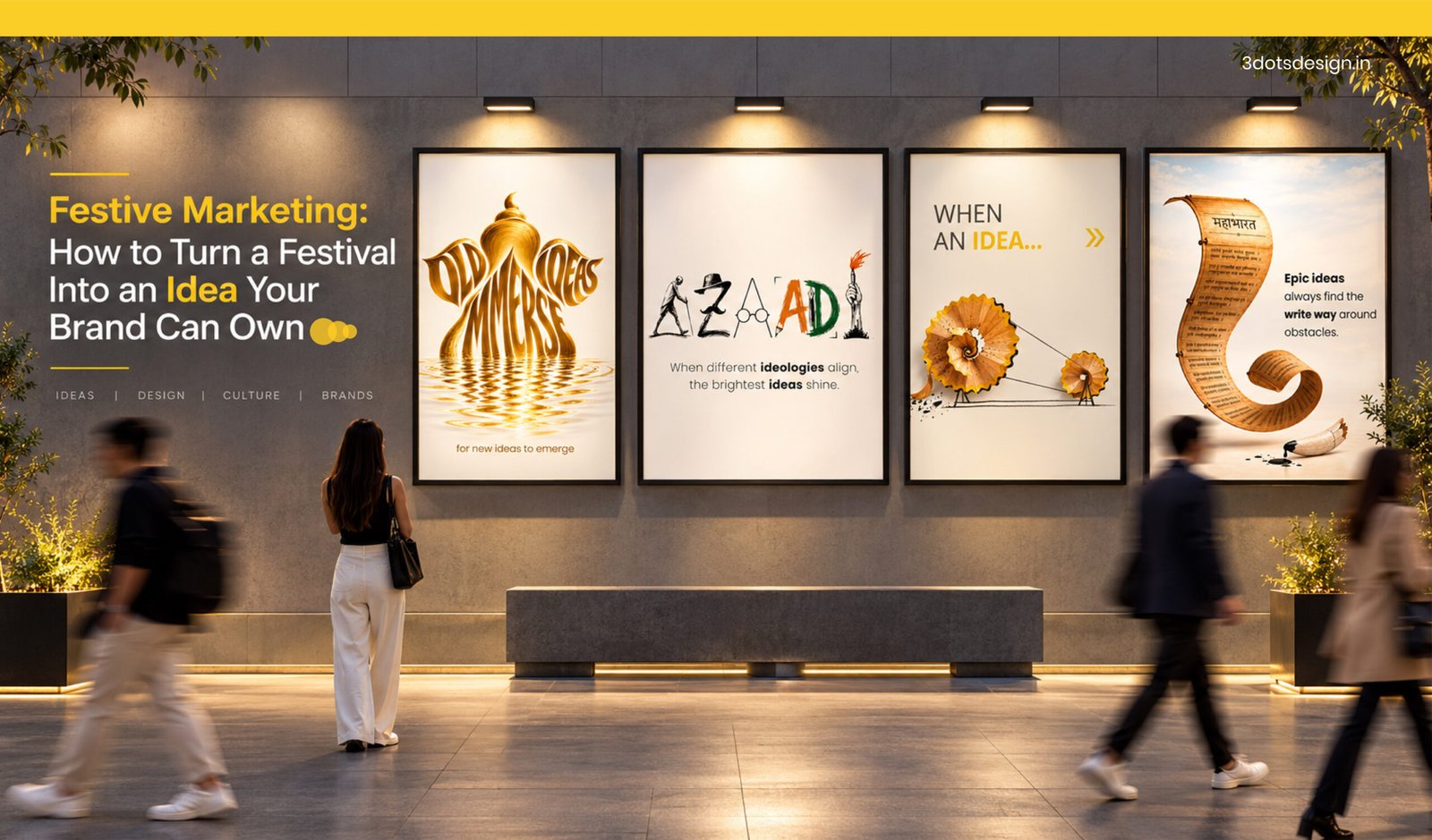
For Independence Day we asked what the occasion means to people who work on ideas, which is what we do. The freedom movement was full of people who held different views and still pulled in one direction, so we gave every letter of AZAADI to a freedom fighter, each shown through one trait. A man walks with a stick, another has a hat and a moustache, another has round glasses, and a pencil and a pen nib sit inside the saffron and green letters. The last letter is a raised hand holding a flaming pen. The line “When different ideologies align, the brightest ideas shine” has ideologies and ideas in bold so the eye catches the link.
View this post on Instagram
Before you brief anybody, try finishing the sentence “for a ___, this festival means ___”. If you can only finish it by lying, skip the big idea.
Boil it down until everyone gets the same thing
Even when the overlap is right, it can be too specialised for the person scrolling. Picture a Diwali post for a coding company with the greeting written in brackets and semicolons. Developers will get the joke and everyone else gets punctuation, so a better version keeps one nod for the developers and writes the main line in plain words.
Our own version of this problem was creativity, which cannot be photographed. For Gandhi Jayanti, we brought it down to something that has been in almost every school bag: a pencil. Shavings joined by a line became a charkha, a pencil stood in for the walking stick with a hand gripping it, and two crumpled yellow paper balls became round glasses. Across three slides, the line reads “When an idea… becomes a symbol… it becomes impossible to forget.”
View this post on Instagram
Anybody who has sharpened a pencil understands it before their thumb stops moving. Ask what everyday object your audience touched this week that could carry your idea.
Let the letters become the picture
Some ideas live where the words and the visual are the same thing. For Ganpati visarjan, we never drew an idol. The words “Old ideas immerse” are set in the shape of Ganpati in gold, standing in water, with the reflection rippling underneath and a smaller line saying “for new ideas to emerge”. The letters are the idol, and the ripple lets you watch the word immerse happening in front of you, which a paragraph of explanation could never do as quickly.
View this post on Instagram
This only works when the writer and designer sit together from the first sketch, because the line has to be short enough to bend into a shape and the shape has to stay readable. Once you have a line you like, ask whether the letters themselves can become the picture.
Borrow the story the occasion already has
Festivals come with stories and most of us only use the date. Ganesh Chaturthi gave us the best brief we never had to write: when Sage Vyasa dictated the Mahabharata, lord Ganesha broke off his own tusk and used it as a pen so the writing wouldn’t stop. Our whole business runs on ideas and the written word, and here was a god acting as the original scribe.
The scroll curls like a trunk with Mahabharata written at the top, and the broken tusk lies on the floor with ink leaking from it. The line says “Epic ideas always find the right way around obstacles”. Epic nods at the Mahabharata; obstacles nod at Ganesha being the remover of them and write is the tusk doing its job.
View this post on Instagram
Read the story behind the occasion and look for a character whose job resembles your client’s job. The tusk works because it is a tusk and a pen at once, and an object that does two jobs can carry an idea without any caption.
Say the deep thing so people get it in a second
An idea can sound smart in the meeting room and still do nothing on the feed, because the person scrolling won’t stop to decode it. The lines we like usually read as a simple message first and say something more underneath. “Some bonds are rough around the edges, but they keep you sharp” works as a Rakhi wish for any sibling, and it also says something about the people you work with. “When an idea becomes a symbol, it becomes impossible to forget” looks like a line about a man and his spectacles, and it’s also a line about what every brand wants to become.
When we write the festive post copy, we run a quick copy and creative matching check. Cover the line and see what the visual says alone, then cover the visual and see what the line says alone. If both say the same thing, one of them is being lazy. In the Rakhi post, the picture shows the rough edges and the line says what rough edges are good for. Then show it to somebody outside the team without a word of explanation. If they explain it back correctly, the idea works, and if they read something different, you should listen, because their reading might be better than yours. A blank face means the idea only makes sense to the people who made it.
So next time the list lands in the inbox, pick up a pen before you take a deep breath. The idea is usually lying around somewhere close, probably in the pencil box.